

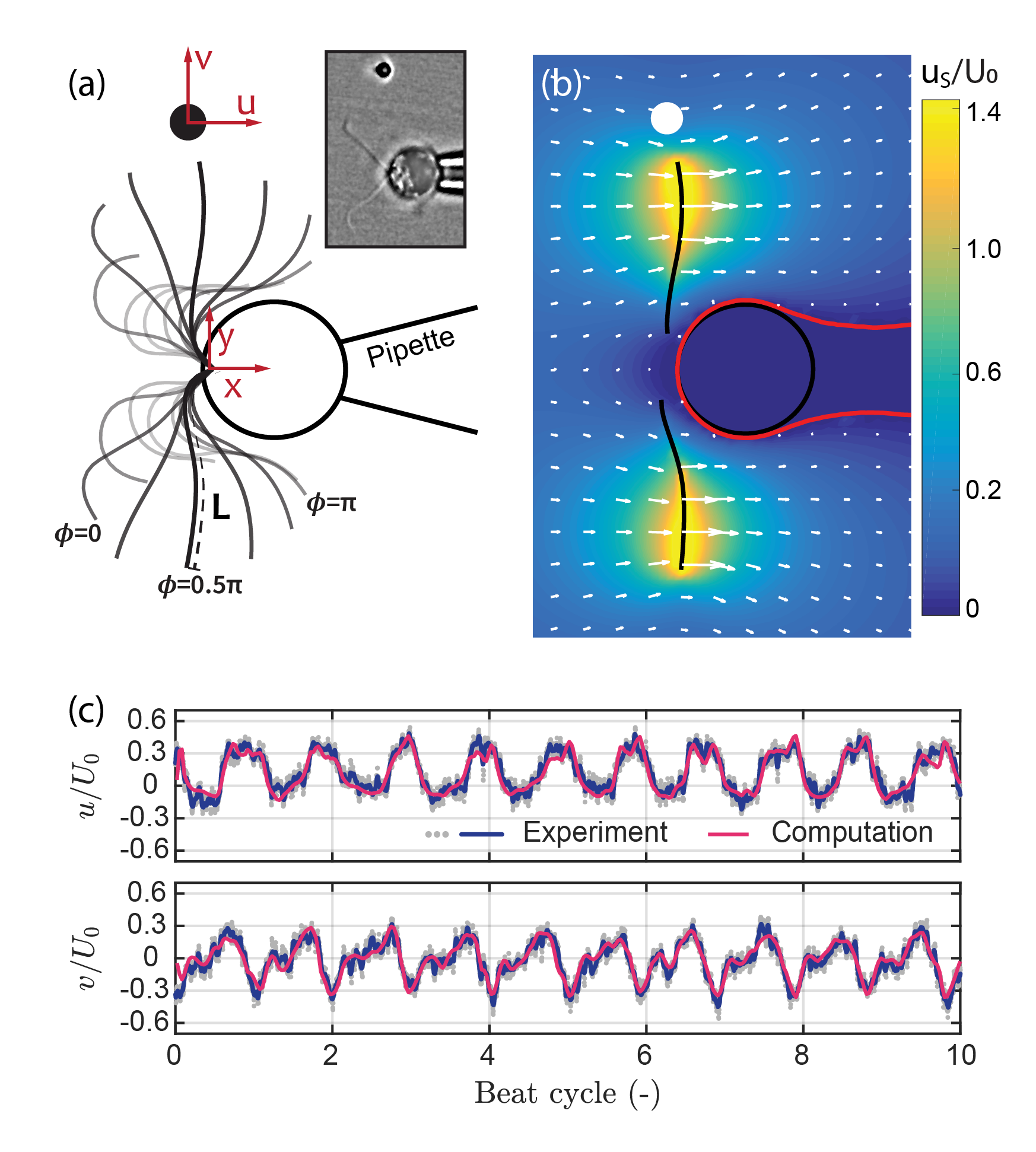
To measure the ciliary flow with a high temporal resolution, we implement an optical-tweezers-based flow velocimetry (OTV). In this technique, a bead is trapped by a focused laser beam and reports the local flow velocity by its displacement from the laser focal point. Essentially, the desired temporal resolution in measuring the flow (0.1 ms) is achieved by employing back focal plane interferometry in monitoring the bead displacement Δx(t).
The left figure shows the typical experimental configuration (a), the Boundary Element Method computation of the flow field (b), and the comparison between the OTV measurement and the BEM computation (c).
It took 2 years (2015.09 - 2017.07) to get the technique to work. And we started to implement it thereafter. After a while, P. Dehnavi elaborated the technique in this paper Experiments in Fluids (2020) 61:202: Optical tweezers‑based velocimetry: a method to measure microscale unsteady flows
Time resolution is not the only advantage of the OTV technique. The key is signal to noise ratio. The trapped bead undergoes confined Brownian motion, whose noise spectrum is a well known Lorentzian function. On this basis, once we have knowledge about the approximate frequency range of the ciliary beating, we can focus filter out all the irrelevant range. This enhanced signal-to-noise ratio helps us to detect flow as low as ~2 µm/s at ~100 µm distance away from the cell. We first revealed that the flow from the cell is increasingly phase shifted.
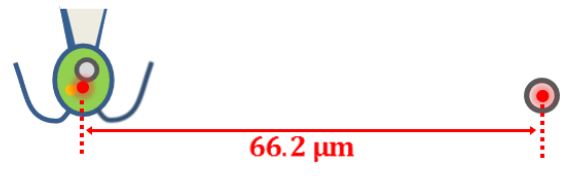
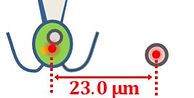
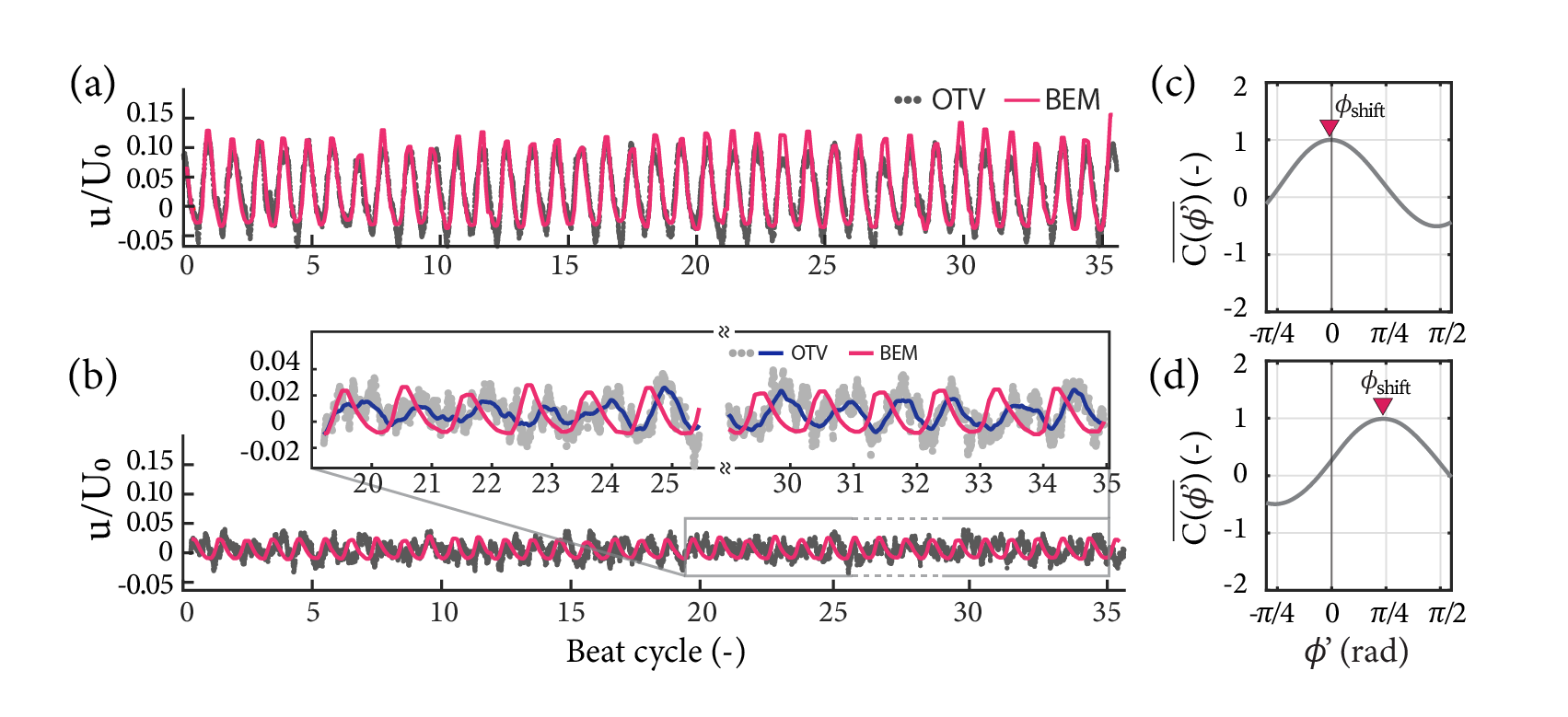
The figure above shows how the measured signal agrees with the Stokes prediction close to the cell (a), in both amplitude and phase (c); and how the measured flow amplitude has become smaller than the prediction and is phase delayed (d). We then characterized the flow's rate of spatial decay and the phase delay in different directions. Results show that the flow behaviors deviate fundamentally from what the Stokes equations predict but are well captured by the unsteady Stokes equations:
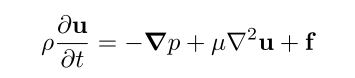
Detail of this work is now published in Physical Review Letters 122: 124502 (2019): Is the Zero Reynolds Number Approximation Valid for Ciliary Flows? A more systematic characterization of the flow around beating cilia of C. reinhardtii can now be found Journal of Fluid Mechanics, 915, A70 (2021): Measurements of the unsteady flow field around beating cilia. In the latter, you can see the transient flow field patterns around beating cilia (dt=~2ms) and hence how momentum (vorticity) propagates.
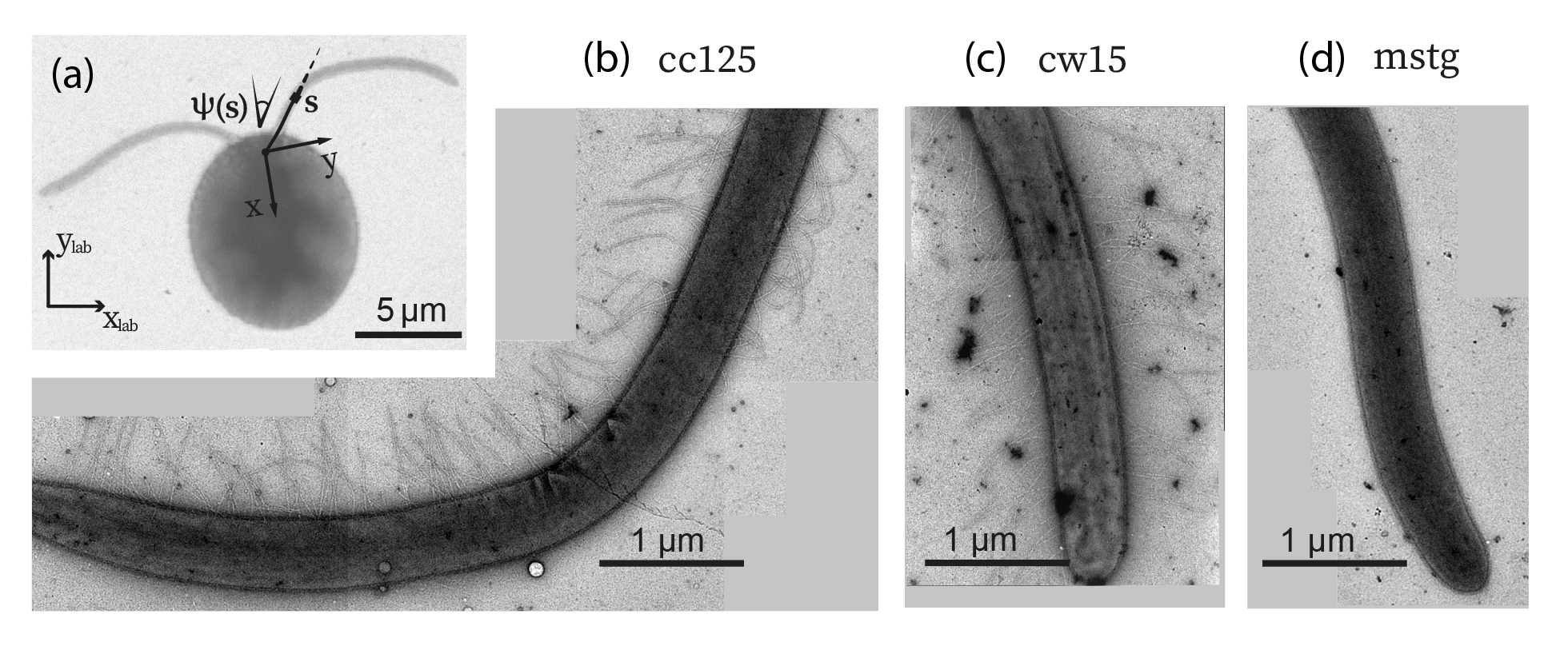
I am hopelessly attracted by the green algae C. reinhardtii. Its hydrodynamics is only a part of my research interest. With the OTV technique, we further characterize the structure-fluid interaction of a flagellar ultrastructure, mastigonemes. Mastigonemes are like hairs protruding from flagella/cilia and there are multiple types of them. The C. reinhardtii mastigonemes have long been thought to enhance the swimming speed of this micro-organism. However, we refute this hypothesis after comparing the OTV flow measurements, numerical simulations, flagellar gait kinematics, and swimming kinematics of the cells with and without this ultrastructure. In the figure above, (a-c) are the TEM images of control groups that have mastigonemes, and (d) the mutant that doesn't. Detail of this work is now published in Biophysical Journal 118, 2914 (2020): Fibrous Flagellar Hairs of Chlamydomonas reinhardtii Do Not Enhance Swimming
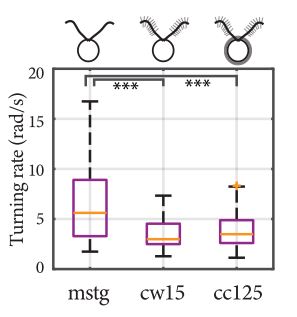
Although the mastigonemes' missing seem to make no difference in flagellar propulsion, it does change the cells' swimming. Preliminary data show that the cells without mastigonemes undergo abrupt turnings more frequently. Our speculation is that these structures are part of the sensor subunits, and are involved in the motion control. Some recent findings support this hypothesis.
The green alga C. reinhardtii swims with synchronous, breaststroke-like beating of its two flagella, and steers by modulating the beating amplitudes differentially. This strategy hinges on inherent flagellar asymmetries being effectively coordinated within the synchrony. Combining high-speed imaging, mechanical measurements and modeling, we show that the two flagella are age-asymmetric in their mechanical properties, and that the younger flagellum sets the beat for the older one — resolving a decades-old speculation about which flagellum leads the synchrony. Published in eLife 13:e86102 (2024): The younger flagellum sets the beat for Chlamydomonas reinhardtii (cover story, selected for eLife digest).
Direct mechanical coupling is known to be critical for ciliary synchronization, but its actual role is elusive in living samples. We built an artificial ciliary system — two cilia formed by chains of self-propelling robots anchored to a shared base, purely mechanically coupled — which mimics biological ciliary beating while allowing fine control over the dynamics. The artificial cilia exhibit rich motility patterns, including two distinct synchronous modes analogous to those observed in C. reinhardtii. Published in Physical Review Letters 133: 048302 (2024): Biomimetic Synchronization in Biciliated Robots (APS News, Editor's Suggestion).