

Turbulent flows are observed in low-Reynolds active fluids, which display similar phenomenology to classical inertial turbulence but are of a different nature. We experimentally measured the real-space structures and kinetic energy spectra of bacterial turbulence from two to three dimensions. The turbulence shows three regimes separated by two critical confinement heights, resulting from the competition of bacterial length, vortex size and confinement height. The kinetic energy spectra display distinct universal scaling laws in the quasi-2D and 3D regimes, independent of bacterial activity, length, and confinement height, whereas scaling exponents transition in two steps around the critical heights. The scaling behaviors are well captured by a hydrodynamic model we develop, which employs image systems to represent the effects of the confining boundaries. Published in Advanced Science, 2402643 (2024): Scaling Transition of Active Turbulence from Two to Three Dimensions (selected for the Journal's annual paper, 64/~5000).
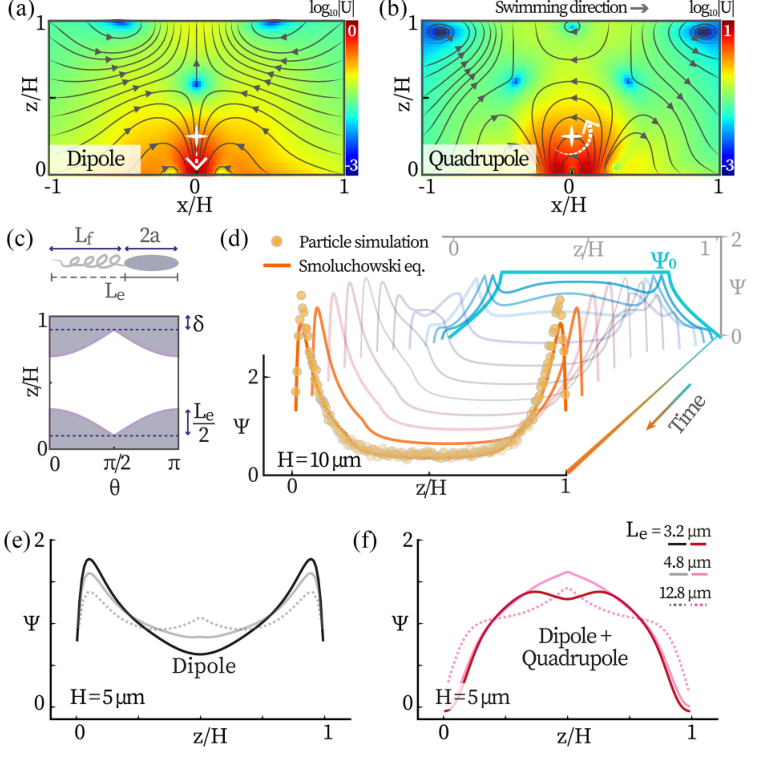
Many swimming bacteria naturally inhabit confined environments. Combining experiments, continuum modeling, and particle-based simulations, we show that confinement reduces near-surface accumulation of swimming bacteria and facilitates their escape. These effects are quantitatively captured by models incorporating the force quadrupole — a higher-order hydrodynamic singularity that generates a rotational flow reorienting bacteria away from surfaces (image flow fields above). Under strong confinement, bacterial trajectories straighten due to the balancing torques exerted by the opposing surfaces. The findings highlight the role of hydrodynamic quadrupole interactions in near-surface bacterial motility, with implications for microbial ecology, infection control, and industrial applications. Published in Physical Review Letters 135: 188401 (2025): Confinement Reduces Surface Accumulation of Swimming Bacteria
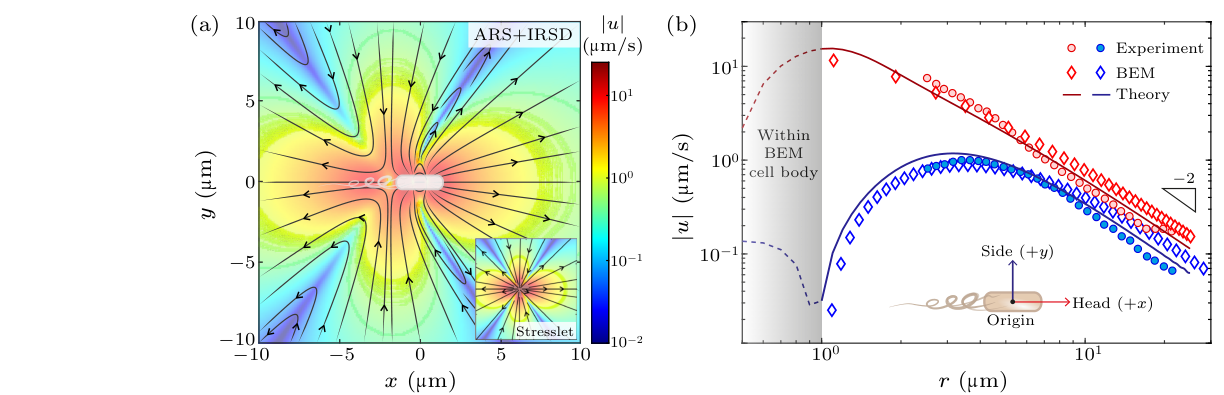
The flow field generated by a swimming bacterium is the fundamental building block for understanding hydrodynamic interactions between bacteria. The force-dipole (stresslet) description captures the far field but fails in the near field, which matters in microswimmer interactions. We propose a model combining an anisotropically regularized stresslet with an isotropically regularized source dipole. It quantitatively reproduces the experimentally measured flow field around a swimming E. coli and our boundary-element simulations of a helical microswimmer, in both free space and confined space with a no-slip wall (figure above: entire modeled flow field and the head/side flow profiles against experiment and simulation). This provides a practical tool for obtaining a bacterium's flow field and for studying collective responses in dense suspensions. Published as an Express Letter in Chinese Physics Letters 43: 050901 (2026): Modeling Bacterial Flow Field with Regularized Singularities
The accumulation of microswimmers near walls has been studied for decades, yet the role of cell-cell interactions remains understudied. In realistic, crowded environments such interactions are crucial. We demonstrate that crowding actively weakens bacterial surface accumulation: analysis of entrapped cell tracks reveals that crowding enhances orientational fluctuations, which increase the effective rotational diffusion and facilitate wall escape. A minimal model shows that this collective effect is equivalent to raising the system's effective temperature with density. Published in PNAS 123: e2536051123 (2026): Crowding limits relative bacterial surface accumulation with density-induced effective heating